{{ lmShot.alt }}
{{ lmShot.label }}
Open to internshipsfor Summer 2027 Let’s talk
{{ hoverName }} View project ↗
01 Principle Solve a real problem It has to be clearly better than what people use today, for a problem they run into again and again.View Payments case study ↗
01 Principle Fit into the day Easy to start and easy to keep using, because it sits inside something people already do.View SME lending case study ↗
03 Principle Help people feel seen People come back to things that show who they are and earn them respect from others.View LifeMint case study ↗
04 Principle Better with every user Each new person should make it more useful for everyone else. And it has to launch when the timing is right.View LifeMint case study ↗

I turn ambiguity into product decisions.

Product designer in Dubai.
Currently designing at botim business.


Projects
01PaymentsCase study →
02SME lendingCase study →
03LifeMintCase study →
Currently designing at
botim businessAstra Tech
Selected for
Dubai Future FoundationUniversity Entrepreneurship Program
~90K transactions analysed
Currently designing at
botim business Astra Tech
Selected for
Dubai Future Foundation UEP
Focus · journeys
01Payments
02SME lending
03LifeMint
Analysed
~90K
payment transactions
~70%
repeat Paylink activity
~100K
merchants
Where those principles took the work
Payments

Two payment products became one request.

A clearer collection experience, built from merchant behaviour, transaction analysis and product simplification.

botim businessAstra Tech· 2026
SME
lending

Made the application understandable to merchants.

The lending journey redrawn across discovery, onboarding, document upload and support.

botim businessAstra Tech· 2026
LifeMint
LifeMint app screens

Helped young people prove what they can do.

Early startup venture · Product design · 2026
Dubai Future Foundation University Entrepreneurship Program

A network where students and recent graduates in the UAE gain experience, build relationships and show what they can do through practical projects.

About

Hi, I'm
Khansa.

Khansa Rubiarto

I'm based in Dubai, studying Product Design and Strategic Design Management while working on projects across different industries.

I've never been good at keeping my interests in one place. Physics, maths, design, and whatever else catches my attention tend to overlap. I like asking why until I get to the root of something, then borrowing ideas from completely unrelated fields to see things differently.

That's what I love about design. It gives me a place to bring together how things work and how they could work differently.

Capabilities

How I work across product, research and strategy.

01
Product Design
Flows, wireframes, interaction design, prototyping
Founded LifeMint and took it from research to a full product system.
02
Research & Validation
Interviews, usability testing, synthesis, insight translation
Interviewed 52 students and SME merchants. Merchant interviews changed my first Payments hypothesis.
03
Product Strategy & Analytics
Behaviour analysis, opportunity framing, prioritisation
Analysed 93,656 transactions to see how merchants actually requested money.
04
Fintech Experience Design
Payments, invoicing, lending, trust-heavy journeys
Took Payments from data to prototype in about 3 weeks. Helped launch SME lending to ~10,000 merchants.
05
Collaboration & Delivery
Cross-functional work, iteration, stakeholder alignment
Worked with credit, risk, partnerships, growth and engineering to ship SME lending.
One more decision

Let's make something people choose.

I'd love to hear what you're working on.

Looking for a product design / strategy / owner internship · Summer 2027.

See you in my inbox.
Skip to section menu
{{ cs.index }} · {{ heroName }}
botim business Astra Tech Dubai Future Foundation University Entrepreneurship Program

Two ways to get paid. One simpler experience.

Making business financing easier to discover, understand, and access.

Experience shouldn’t depend on who you know.

{{ heroLede }}

Outcome {{ cs.snapOutcome }} {{ cs.snapOutcomeSub }}
{{ f.k }} {{ pp.l }} {{ f.v }}{{ f.sub }}
SME lending: working capital in a few taps, from feed card to funds LifeMint app screens
  1. {{ r.n }}{{ r.k }}

    {{ r.v }}

What was the situation?

Figures rounded · some data confidential to botim

{{ ov.title }}

Too much effortto request payment.Too little clarityafter sending.

SME lending wasfragmented beforethe applicationeven began.

Your first opportunityshouldn’t requirea previous one.

{{ ov.method }}

{{ c }}

{{ ov.body }}

01{{ ov.gL1 }}{{ ov.gWho }}{{ ov.gWhoSub }}
02{{ ov.gL2 }}{{ ov.gBroke }}{{ ov.gBrokeSub }}
03{{ ov.gL3 }}{{ ov.gCost }}{{ ov.gCostSub }}
The context, in four beatsRead left to right
{{ c.n }}{{ c.q }} {{ c.lead }}{{ c.a }} {{ c.biz }}pulls against{{ c.usr }}
{{ numLabel }}
1 in 3entry-level jobs ask for years of experience
14,687 entry-level postings · June 2026
Entry-level posting
Entry-level posting
!
Asks for years of experience
Invoice · elapsed time
1+ weekto get paid
✓
CreatedDay 1Day 2Day 3Day 4Day 5Day 6Paid
~5 min to create7+ days waiting
Creating an invoice took minutes. Payment arrived a week or more later. Transaction sample, figures rounded.
Paylink · repeated behaviour
~70%repeat
~70% repeat Paylink activityRepeat requests accounted for a substantial share of Paylink activity.Same merchant, amount and descriptionOne-off requests
Repeat means the same merchant, amount and description recurring. Transaction sample, figures rounded.
{{ ov.stat }} disconnected problems
It was one lending funnel, but every stage had been designed and owned on its own.
{{ pc.n }}{{ pc.k }}{{ pc.v }}
Merchants dropped out in the gaps between those stages, because nothing joined them up.
{{ ov.statLabel }}
{{ ov.stat }}

{{ ov.statCap }}

Each square is 5%
{{ ov.stat2Label }}
{{ ov.stat2 }}

{{ ov.stat2Cap }}

Each square is 5%
{{ ov.flowLabel }} {{ flowHint }}
{{ s.n }} {{ s.k }}
{{ s.stepLbl }}{{ s.k }}

{{ s.v }}

{{ s.cap }}

✓Check your eligibility
Every merchantOnly those ready to borrowEvery merchant
Feed card
Push
Chat
+
Partner
→One lending journey
1/92/93/94/95/96/97/98/99/9
9 separate screens
Step 2 of 3
01 Business✓ Done
02 Documents1 of 3
Trade licence
Bank statements
Owner ID
03 Review3 items
3 clear phases
Trade licence✓
Owners✓
Bank statements✓
Sales report
Needed
Trade licenceEXPIRED
Next stepUpload the renewed licenceUpload →
✓Back on track
Before you sign
OfferAED 50,000
Fees− AED 1,000
You repayAED 53,500
Cash receivedAED 49,000
AED 49,000
✓Funds received
{{ x.l }}
{{ s.toL }}
{{ r.l }}{{ r.st }}
{{ s.dA }}{{ s.dB }}
{{ s.bA }}
{{ s.bB }}
?Design challenge

{{ h.t }}

The problem existed across the whole funnel

I realised this was a system problem: the lending experience ran across six surfaces, and each one had a different owner.

Targeting Which merchants should receive lending communication?
Entry Where does the merchant discover or enter lending?
Partner handoff When another company is involved, who owns which step?
Application What does the merchant need to complete?
Verification What information and evidence must be reviewed?
Recovery What happens when a document is missing, outdated or rejected?
Offer What financial information must be understood before commitment?

The project therefore required product strategy, information architecture, UX and cross-functional alignment.

The real work turned out to be designing the whole lending system, not a better form.

What the research suggested

Many young people already encountered development through clubs, projects, volunteering, student organisations, courses, personal initiatives and informal work.

The problem was that these experiences were fragmented, difficult to navigate, inconsistently recognised, and rarely translated into credible evidence. The research indicated a path problem as much as an opportunity problem.

Students were getting experience. It rarely led to an opportunity.

What did you find?

Four things the research told me that changed my original plan.

Initial assumption

I went in thinking that better targeting and a shorter application would fix it.

The original plan · 1 held, 3 revised
I assumed01 Merchant behaviour HeldThe starting signal
I assumed02 High-potential borrowers RevisedBy insight 01
I assumed03 Simpler application RevisedBy insights 02 and 03
I assumed04 More completed applications RevisedBy insight 04

The research showed I was wrong about both.

The application was only one part of the problem.

From deciding whom to approach to helping merchants recover from missing documents, the lending journey had friction well beyond the screens themselves.

Insight 01
Behaviourover assumptions

A large target list wasn’t necessarily a qualified audience.

ObservedThe targeting model relied on industry, sales volume and assumed loan sizes. Yet roughly 12,000 merchants fell below their assigned score thresholds, accounting for nearly a third of projected volume.
InterpretationThe model was estimating potential before establishing eligibility. Actual product behaviour offered another way to identify engaged merchants.
StatusShipped. Launch audience of ~10,000 merchants, campaign live 14 August.
Led to Decision 01 · Targeting
12Kbelow score threshold
01Eligibility
Serious arrears screened out first
02Behaviour
1products
2–4products
5+products
5×take-up The most engaged go first
3industry messages
03Industry
botim · nowStock for the next order
botim · nowSeasonal inventory
botim · nowGrowth and ad spend
F&BRetailE-commerce
One message per industry
Insight 02
Progresswithout clarity

The form showed progress, but not what was missing.

ObservedThe application used different terms for the same ownership information, requested unfamiliar documents, and made consent status difficult to interpret.
InterpretationA completion percentage meant little if merchants couldn’t tell what was verified, what was missing, or who needed to act.
StatusDesigned. Built with engineering and checked with credit and risk.
Led to Decision 02 · Application
01A number, not an answer 44%
?What's still missing?
3/4checks verified
02Exactly what is needed
Trade licenceValid
Ownership2 of 2
Cash flow3 months
Tax documentNeeded
3stakeholders, own chats
03Each stakeholder, in their own chat
APartner A
Confirm your ID Done
BPartner B
Confirm your ID Done
SSignatory
Confirm your ID Done
Insight 03
Clarityover speed

Fewer screens didn’t mean less uncertainty.

ObservedThe initial partner journey compressed the application into a few screens, but identity, verification and consent still required separate steps.
InterpretationShortening the journey wasn’t enough. Each verification step needed a clear purpose, and merchants needed to know their progress wouldn’t be lost.
StatusShipped. Cobranded partner flow, with the Partner Portal live 18 September.
Led to Decision 04 · Partners
4checks to an offer
01The offer narrows with each check 1 Partner estimate AED 40K – 150K 2 Identity AED 60K – 130K 3 Business check AED 75K – 105K Authority and consent AED 75,000
3×trips out of the app
02Three trips out of the app
botim
back to botim 1Registry 2Digital ID 3Consent
0steps lost
03And returns to the same state
botim
Step 3 of 5
Business check
botimWelcome back
Step 3 of 5
Business check
Insight 04
Beyondthe happy path

The journey broke down when something went wrong.

ObservedThe lending process had four recurring loops: missing documents, risk queries, special approvals and offer negotiations. Each relied heavily on manual coordination.
InterpretationThe application needed more than a clear path forward. It needed a reliable way to recover without making merchants repeat completed work.
StatusProposed pilot. Needs legal sign-off and trained agents.
Led to Decision 05 · Documents
4manual restarts
01Four loops, each restarted by hand Docs Risk Approval Offer
Apply
AED75K
Funds
1/5statements missing
02One missing document, one fix
Jan
Received
Feb
Received
MarMissing
Apr
Received
May
Received
Upload March
1 daytarget to rejoin
03Back on the same step Apply Risk review Offer Funds March uploaded
DocumentsSaved where you left off
So what was the real problem?
Worked withProductLeadership
I moved from

{{ rf.from }}

To

{{ rf.toText }}

{{ rf.coda }}

What did you decide?

Five stages. Five decisions.

My role was different at each stage, so each decision says exactly what I owned. Scroll to watch it work.

01TargetingOwned

Fewer merchants. Stronger reasons to reach them.

1Qualify first2Prioritise by behaviour3Tailor by industry
Acquisition
Relevance
What lending message fits this business?
Readiness
Should they see an offer or eligibility invitation?
Underwriting
Credit decision
What can they responsibly borrow?
This kept acquisition decisions separate from underwriting decisions.
Why it was justified
~100,000 → ~10,000
merchants analysed → pilot groups
Trade-off
I chose a smaller, defensible pilot over a larger forecast built on assumptions.
02ApplicationUX design

A progress bar couldn’t tell merchants what was missing.

1Replace percentage progress2with actionable verification3Each requirement shows status, owner and next action
Why it was justified
9 → 3
back-office steps → merchant phases
Trade-off
Show more meaningful information instead of making the application appear further along.
03RepaymentContributed

Repayment had to work beyond the screen.

1Direct Debit · available at launch2Settlement-based · depends on integration3Design around the method the product could support
Why it was justified
Offer first
the merchant sees the amount before choosing the account
Trade-off
Prioritise a deliverable first phase over promising functionality that depended on future integrations.
04PartnersOwned the design

A referral shouldn’t feel like starting over.

1Cobranded flow: 13 screens, English and Arabic2Partner Portal live 18 September
Why it was justified
~60% vs ~5%
reached submission: partner-referred vs in-app. Different cohorts, so not caused by design alone.
Trade-off
An explicit, trusted transition instead of disguising the move between organisations.
05DocumentsOwned the pilot plan

One conversation. Every document accounted for.

1Requested → Received → Needs correction → Accepted2Proposed pilot: needs legal sign-off and trained agents
Why it was justified
5–6 · 1
5–6 documents per loan, all still required, collected in 1 approved thread.
Trade-off
Test the process manually with trained agents before investing in deeper integration.
01Targeting
100k → 10kmerchants analysed, narrowed to pilot groups
Who we talk to 100,000analysed 10k 1Exclude serious arrears2Rank by products used
What we say
F&BStockto F&B
RTSeasonto retail
ECAdsto e-commerce

Industry stopped deciding who we talk to. It now shapes what we say.

02Application
9 → 3back-office steps, grouped into merchant phases
Back office What the merchant sees
01Eligibility
02Business details
03Owners
04Trade licence
05Bank statements
06Credit consent
07Offer
08Direct Debit
09Agreement
01
Apply3 steps inside
02
Verify3 steps inside
03
Finalise3 steps inside

Merchants track three phases. The back office still runs all nine.

03Repayment
Offer firstthe amount comes before the account
AED 75,000 0 75,000 12
•••• 4821
Direct Debit 3
04Partners
13cobranded screens, partner details carried across
Business
Owner ID
Bank
+
Business
Owner ID
Bank
Partner app botim
13 screens, both logos on every one
05Documents
5–6 → 1documents per loan, one approved thread
%1 threadRequestedReceivedFixAccepted
What does it look like for a merchant?

One journey, from offer to funds.

The redesigned application, the document thread and the recovery states, in one connected flow.

Worked withEngineeringCreditRisk

I built the journey with engineering and checked every step with credit and risk.

01ApplicationThree phases, so merchants always know what’s left.
02OfferFrom offer to signed agreement.Scroll through the nine steps
03RecoveryMissing documents recovered in one chat thread.
What’s underneath the screens?

{{ cs.constraintsLead }}

AreaThe constraintWhat I decided
{{ c.design }}{{ c.constraint }}{{ c.decision }}
Trade-offs

Every simplification had a limit.

Select one to see what I chose.

Coordination, through one example

One requirement, through the system.

An expired trade licence, from the rule that requires it to what the merchant sees and what shipped.

  1. 01 · RequirementA valid trade licenceNeeded before an offer can be made.
  2. 02 · Responsible ownerCredit, merchant, agentCredit and risk decide what counts as valid. The merchant renews and uploads. An agent records the document in the lending system.
  3. 03 · Merchant-facing state“Your trade licence has expired.”Next step: upload the renewed copy.
    Expired
  4. 04 · Recovery actionUpload, then resumeThe renewed copy goes into the approved BOTIM Business thread. The application resumes where the merchant left off.
    Accepted · resumed
  5. 05 · Release statusPartly live, partly proposedThe application states were built with engineering. Collecting documents in chat is a proposed pilot.
    Proposed pilot
I designedThe expired state, the next action, and returning the merchant to the same step.
Credit and risk requiredA valid licence before any offer, with documents and decisions kept in the lending system.
Engineering supportedBuilding the application journey with me, checked step by step with credit and risk.
Still waiting on approvalChat collection, which needs legal sign-off and trained agents.
So what changes for merchants?

What I delivered was a focused cohort and one connected lending journey.

Worked withLending managerPartnershipsGrowth

We agreed who to target first and how we’d track the journey after launch.

Rami Tradingmerchant · illustrative

Why did I get the offer and not everyone?

I analysed ~100,000 merchants and picked the ~10,000 ready to borrow first.

~100,000merchants analysed for targeting
~10,000in the launch audience

Will I actually hear about this loan?

I ran an eligibility-check campaign inside the app. ~10,000 merchants reached at launch, live 14 August, with AED 0 paid media.

Where the offer showed up~7 surfaces
In-app banners“For You” cardsPopups

Did more people actually apply?

10×+ weekly leads and ~4× submitted applications after launch.

After launch vs beforeteam result
10×+weekly leads
~4×submitted applications
~50%of started applications reached submission

Does it matter how I get in?

~60% of partner-referred applications reached submission, vs ~5% from in-app entry.

Partner-referred~60%
In-app entry~5%
Different cohorts, so not caused by design alone.

So where did people get stuck?

By 13 September, nearly 2,000 applications were created and about 300 submitted. About 3 in 4 of those sat in offer review, and ~2 in 3 applications never reached the first form step.

Created~2,000
Submitted~300
Stuck in offer review~3 in 4

What happens next?

Stop pushing acquisition. Give the review queue an owner, retarget the banner to the strongest cohort, and follow up merchants stuck on uploads.

How I worked

Met my lending manager every week to review progress and get feedback on my work.

Lending journeyTook the co-branded lending journey through three versions in four days, growing it from 11 to 13 screens after design review.
Competitor updateAt their request, set up a weekly competitor update tracking rival lenders’ pricing, eligibility, partnerships and UX changes.
Cohort analysisReworked my merchant cohort analysis from ten cohorts to six, dropping company size and GMV as targeting variables once activity proved a better predictor of take-up.
StakeholdersProposed repositioning the SME lending launch product around supplier-payment protection in the team’s strategy review, and prepared partner-facing decks for four payment and commerce partners.
TrackingKept a weekly project update for SME lending across six weeks, covering open decisions, risks and next steps.
SurveyDesigned a three-minute merchant survey on turnover, industry and payment methods to inform SME lending targeting.
WireframesSketched low-fidelity onboarding screens before building the high-fidelity SME lending flow.
Offer
Business details
Documents
Review and sign
Funds sent
How did your thinking move?
{{ cs.nextLead }}

{{ cs.nextFunnel }}

{{ cs.nextTail }}

{{ r.n }}♠{{ r.k }}{{ r.v }}
If your team is working on problems like this, I’d love to talk.
khansarubiarto@gmail.com
Say hello
So where does someone begin?

I investigated why gaining meaningful experience remains difficult, even when learning resources, professional networks, and opportunities already exist.

Miro research board mapping LifeMint's problems, idea, system architecture, business model, competitors and adoptionResearch board
Problems, competitors, system layers, business model and adoption mapped in one place before narrowing the concept.
Initial assumption

How do we capture the learning school doesn’t measure?

Insight 01
~5%of postings say what else counts as experience

Ambition was already there.

ObservedStudents already have real experience. Almost no posting says it counts.
DecisionMake real contribution count as evidence, not more content.
StatusDesigned in the Mission record. Not yet tested with hirers.
On the CV versus what they actually did
Insight 02
4connected needs

Students needed a path.

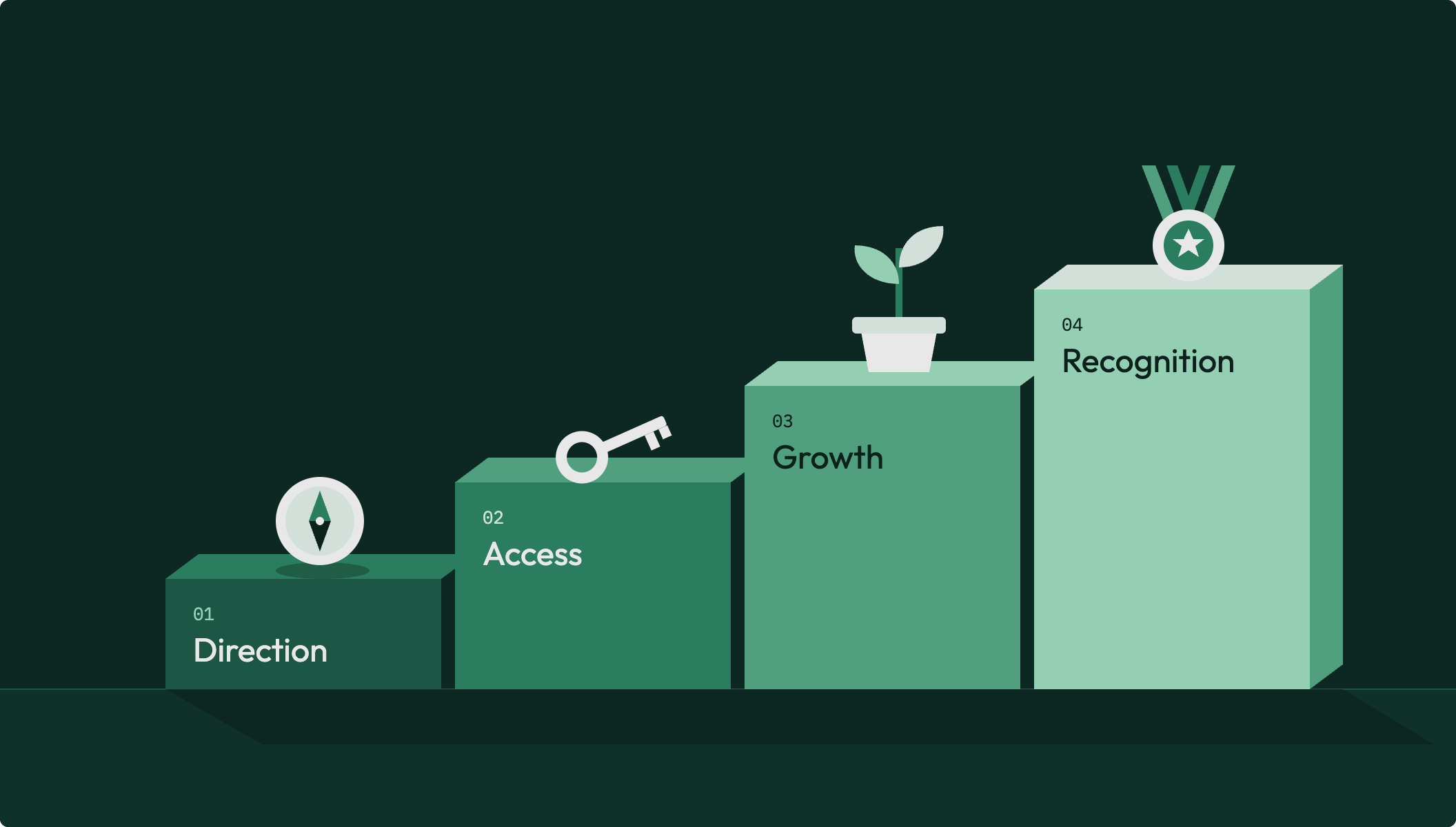
ObservedEach need was really a question, asked in order: direction, access, growth, recognition.
DecisionDesign one connected loop instead of another opportunity marketplace.
StatusDesigned as the MVP loop. Not yet tested with users.
A path in four steps: direction, access, growth, recognition
Insight 03
7facts every Mint keeps

Trust turned out to be the real product problem.

ObservedA badge that says “good communicator” means very little on its own, so the value is in making the evidence behind it trustworthy.
DecisionEach verified contribution keeps what was done, the role, evidence, collaborators, outcome, verifier and context.
StatusDesigned. Whether a record separates one person’s contribution is still an open question.
A claim versus a Mint with seven facts inside
Insight 04
1testable question

The best MVP turned out to be the smallest question I could ask.
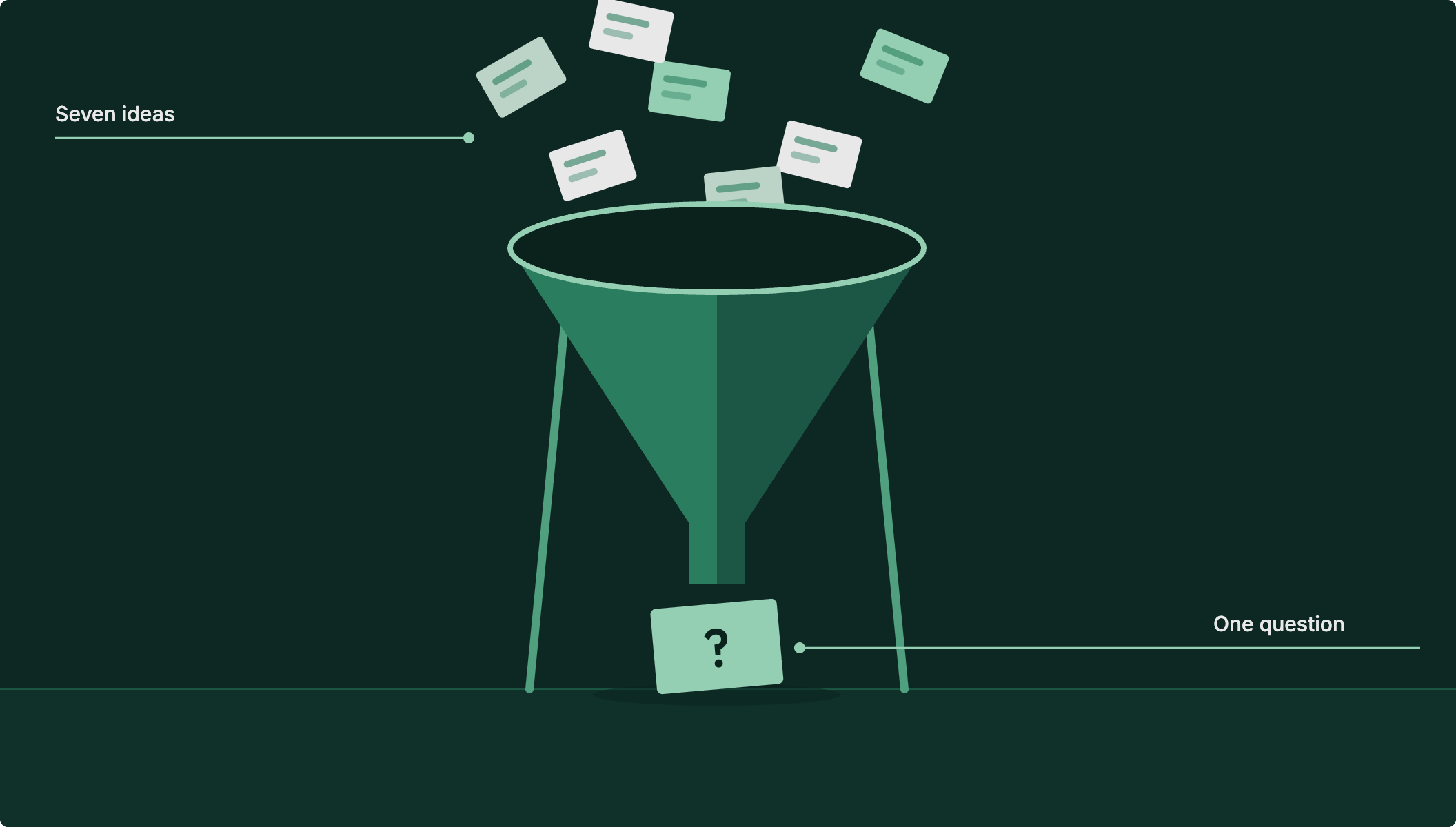
ObservedLifeLab had blockchain credentials, time banking, geofenced quests, skill graphs, peer exchange and more, and building all of it first would have hidden what actually created value.
DecisionSo I reduced the vision to one question I could test.
StatusScoped. Pilot planned, not yet run.
Seven ideas narrowed to one question
How did the idea change?

Three versions, each one narrowing the question.

V1LifeLabToo wide

“How could we redesign learning?”

Skills, community projects, credentials and a contribution economy, which was far too wide to test.

V2ProofHalf the loop

“How could a real contribution become portable proof?”

Verified records solved recognition, but assumed people already had the experience to record.

V3Growth networkThe loop

“How could people gain the experience their next opportunity requires?”

Evidence stays, as an input to the next experience rather than the end product.

So what was the real problem?
The original direction

{{ rf.from }}

A better profile only helps at the last step. It doesn’t help people find work, build skills or earn evidence.

How might we help peoplegain meaningful experiencebefore they areexpected to have it?

From presenting experience to creating it.

For individualsHow can someone move from uncertainty to a meaningful first action?
For organizationsHow can they offer manageable opportunities without excessive admin?
For employersHow can smaller experiences count when someone has little work history?
Backed by2 hiring interviews36,000+ job postings12 postings broken down11 platforms analysed
Decisions
How did you know the reframe was right?

Four questions that shaped every decision.

Each one picks up where the last left off, from two interviews to 36,000 job postings.

Swipe sideways to read the map → Tap a tab to switch maps.

What did you decide?

Four insights, and the six decisions that came from them.

Each decision answers something I learned in discovery. Scroll to watch it work.

From Research 01· hiring interviews
Decision 01

Start with direction.

Instead of asking for a career, LifeMint starts with interests, goals, scenarios and emerging strengths.

A direction to testStrengths surface through action
WhyHirers judge what someone can do, not what they say they want. Starting from a club someone ran or a family business they helped in turns experience people don’t count into a direction they can test.
From Research 01· hiring interviews
Decision 02

Bridge interest and real responsibility.

Quests sit between curiosity and real work, so commitment can grow over time instead of being demanded on day one.

Discover → Quest → MissionLow-risk practice first
WhyThe HR lead said graduates need a mentor and really clear KPIs. Going straight to work an organisation depends on is too big a jump, so Quests are optional practice, never a gate before a Mission.
From Research 03· 36,000+ postings
Decision 03

Turn real work into evidence.

Completing a Mission creates a structured record of the work.

Brief, work, evidence, outcomeReviewed by the host
WhyA finished deliverable hides how someone worked. So each record keeps the brief, the work, the review and the outcome together.
From Research 02· 11 platforms
Decision 04

Make trust inspectable.

Instead of asking people to trust a badge, LifeMint shows the evidence behind it.

Who verified it, and whyA way to correct the record
WhyA signed credential proves who issued a record, not that the work was real. So every record names an accountable reviewer and can be challenged.
From Research 04· role families
Decision 05

I had to protect the MVP from the vision.

The first version keeps only what tests the core loop, and everything else waits.

Seven parts in the MVPThe rest deferred for later
WhyExperience is the only barrier in 24–33% of sales, HR, admin and operations postings. The first loop starts there and stays small.
New idea· proposal, not proven
Decision 06

Inherit and improve real work.

Let people inherit and improve real work, rather than always starting a new project. Their Mint Profile records exactly what they changed and whether the handover worked.

Judgment, communication, responsibilityCollectives hand work to newcomers
WhyMicrosoft’s May 5, 2026 Work Trend Index identifies checking AI output and critical thinking as increasingly important human skills. Its survey covered 10 markets, excluding the UAE, so this supports a direction rather than proving local demand.
What does it look like for a student?

Every contribution shapes the next one.

Each step builds on the last.

AI experience engineRecognises prior abilities · identifies what needs development
WritingOrganisingDesignCodingLeading
01Identity

A direction to try.

Quest screenScreen +
2 of 3 quests
02Quests

Short, optional practice for the gap that’s left.

Mint screenScreen +
Event brief
03Missions

Real work becomes a record that stays with you.

ARYouM
Teammates confirm your part
04Collectives

You work as a team and still prove your own part.

Evidence from the Mint Profile informs the engine’s next recommendation
Mint profile screenMint profile +
02 · Who it’s for

Three groups, one network.

It starts with students and recent graduates in the UAE.

03 · Behind a Mission

The agent drafts. People decide.

04 · The flow

From a quest to a Mint someone can share.
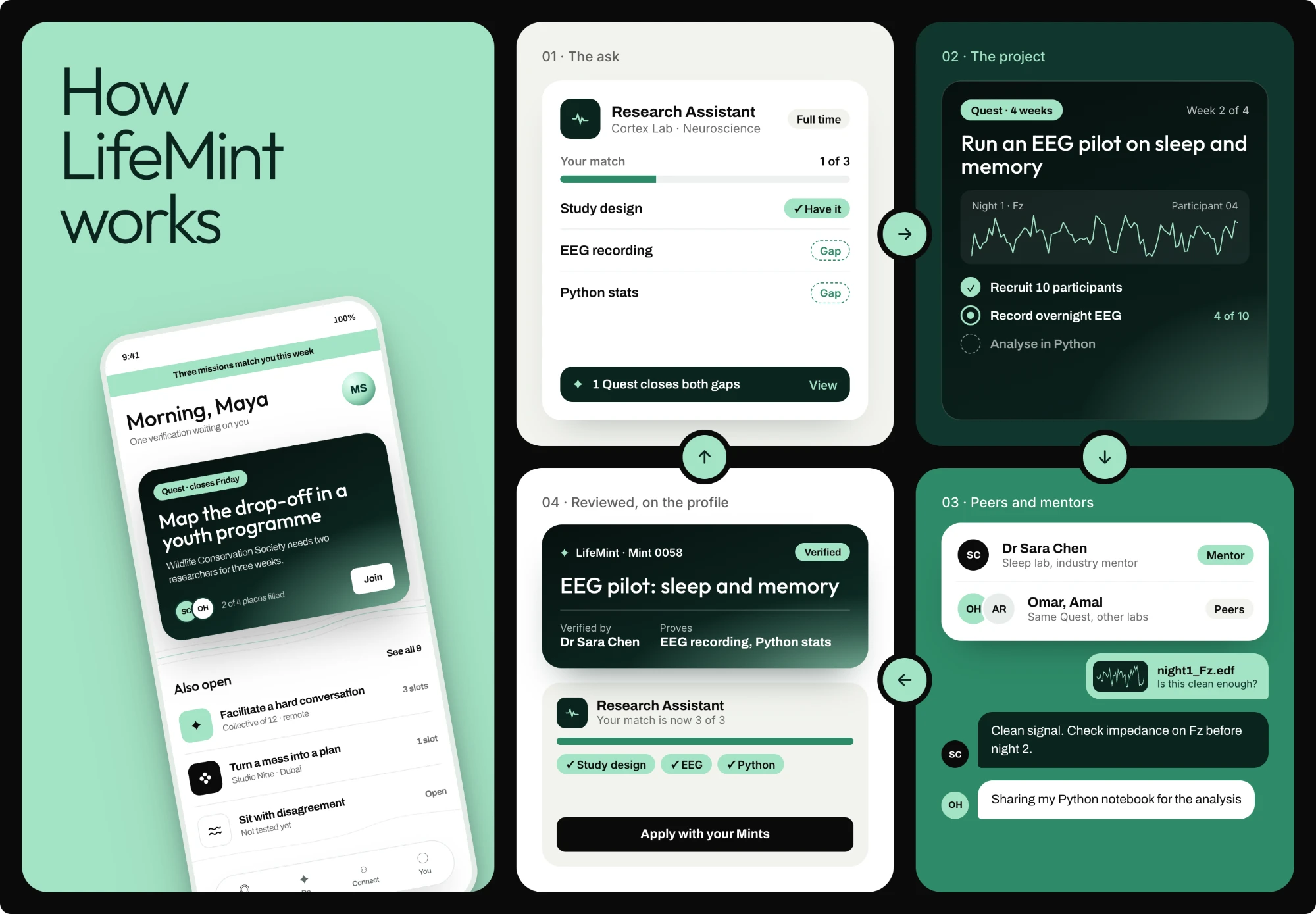
Five steps, one memberWireflow
9:41100%
Discover
Quests for you
Map the drop-off in a youth programme 1
01DiscoverQuests are matched to the member's goals and skills.→ Taps a quest
9:41100%
Quest
Map the drop-off in a youth programme
2 of 4 places filled
Join quest2
02QuestThe brief, who posted it, how long it runs and who has already joined.→ Joins the quest
9:41100%
Do
4 of 7 steps
Interview eight volunteers
Code the transcripts
Write the drop-off memo
Waiting on others
Submit for verification3
03DoThe work is broken into steps. Each one is logged as it is finished.→ Two collaborators vouch
9:41100%
Your Mints
Verified Volunteer research
Verified byIssuedVouches
Share this Mint4
04MintOnce verified, the work becomes a Mint showing who vouched and when.→ Shares the Mint
9:41100%
Your Mints
Share Volunteer research
lifemint.me/maya/0041
Copy link LinkedIn Add to CV
Done
05ShareA link anyone can open to see the work and who verified it.
Key screens across the loop. Swipe to see more →
How LifeMint works: the ask, the project, peers and mentors, reviewed on the profile
How LifeMint works. Swipe to see more →
05 · Trade-offs

Building trust meant making trade-offs.

Pick one to see where I landed.

Verification, through one record

What a verified Mint actually proves.

One existing example: a volunteer research Mission. A verification stamp should not imply more certainty than the system gives, so the record says what was checked and what was not.

What was submitted?

Interviews with eight volunteers, coded transcripts and a drop-off memo, submitted as the Mission’s steps.

Who reviewed it?

The Mission host reviews the work. Two collaborators vouch for the member’s part in it.

What did they verify?

The host confirms the brief was delivered and records the outcome. Collaborators confirm who did what.

What does the record keep?

The brief, the work, the evidence, the role, collaborators, the outcome, the named reviewer and the context. Every record can be challenged and corrected.

What is still a claim?Open question

The skills the member says they built. Whether a record can separate one person’s contribution from the team’s is still an open product question.

Where does it lead?

Evidence from the Mint Profile informs the next recommendation, so the record shapes the next Quest or Mission.

Status: concept. These rules are designed but not yet tested with hosts or hirers.

So what changes for students?
A smaller product, a trust model hirers already recognise, and a pilot ready to test it.
Sarastudent · illustrative

Is this live yet?

Not yet. Research, product model and pilot plan are done, so there are no outcome numbers and I won’t invent any.

What did the research actually show?

Entry-level jobs ask for experience students can’t prove.

Evidence behind the design
36,000+entry-level postings coded
11platforms reviewed
5hiring themes, each a design rule
1focused loop from a much broader vision
Trust modelbuilt on evidence, verification, privacy and correction

So what would change for me?

A clearer path from not knowing where to start to proof you can show.

UserA clearer path from uncertainty → action → real experience → proof.
ProductA broad education concept became a focused, testable behavioural loop.
BusinessThe next validation is tied to whether students, mission hosts and reviewers actually see value.

How will you know it works?

Five assumptions, each with its own test.

01Employers will accept evidence other than a CVIf wrong: the record opens no doors. Test: ask each partner which alternative evidence it accepts before the Mission, then track follow-through.
02A Mission delivers useful work within a realistic review timeIf wrong: reviews slip and members wait. Test: log promised vs actual review time on every pilot Mission.
03Someone will pay for the supportIf wrong: free participation has nothing funding it. Test: will institutions or sponsors fund mentor capacity, and at what price?
04A record can separate one person’s contributionIf wrong: readers can’t tell what the member did. Test: reviewers read pilot records and say what each member did alone.
05The record helps someone reach a next responsibilityIf wrong: a tidy archive that changes nothing. Test: follow pilot members to their next role, project or Mission.

What’s the pilot?

Proposed: 2 high schools, 2 universities and 3 youth organisations. 100 completed Quests and 200 delivered Missions. No backend, revenue or confirmed partner yet.

Fundingsubmitted
AED 50KDubai Future Foundation · UEP application
How did your thinking move?
{{ r.n }}♠{{ r.k }}{{ r.v }}
If your team is working on problems like this, I’d love to talk.
khansarubiarto@gmail.com
Say hello
What did the data actually show?

I went into the data to fix two products. I came out with a different brief.

Signal 01

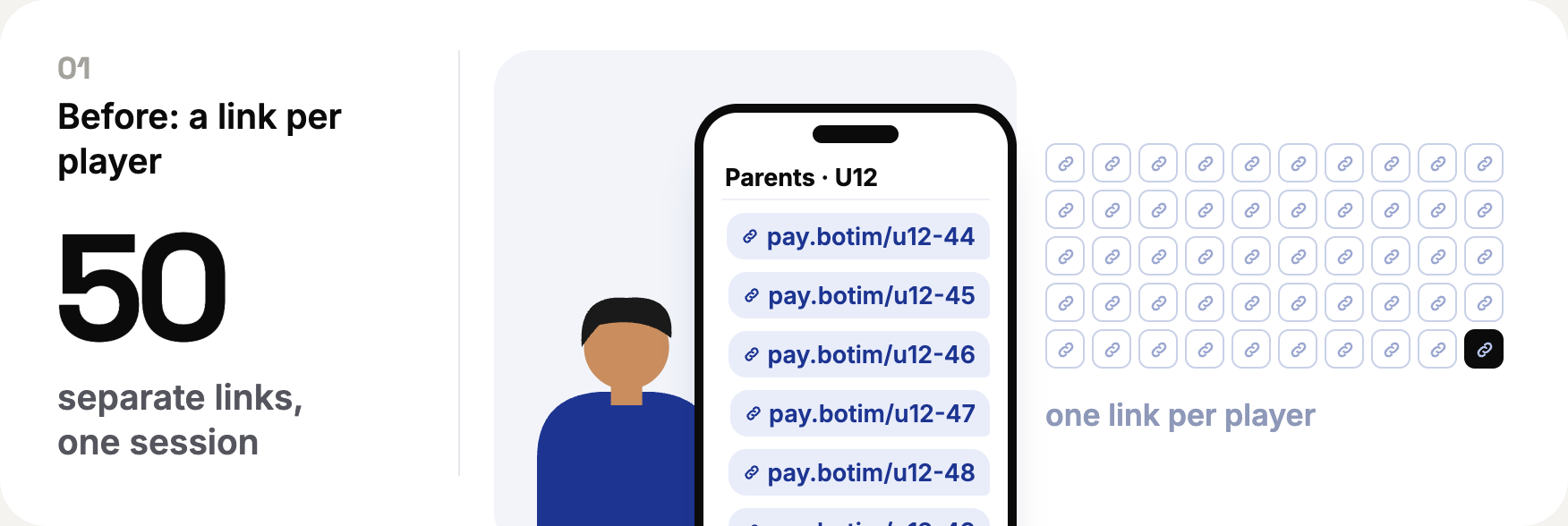
One academy. Fifty links. Every week.
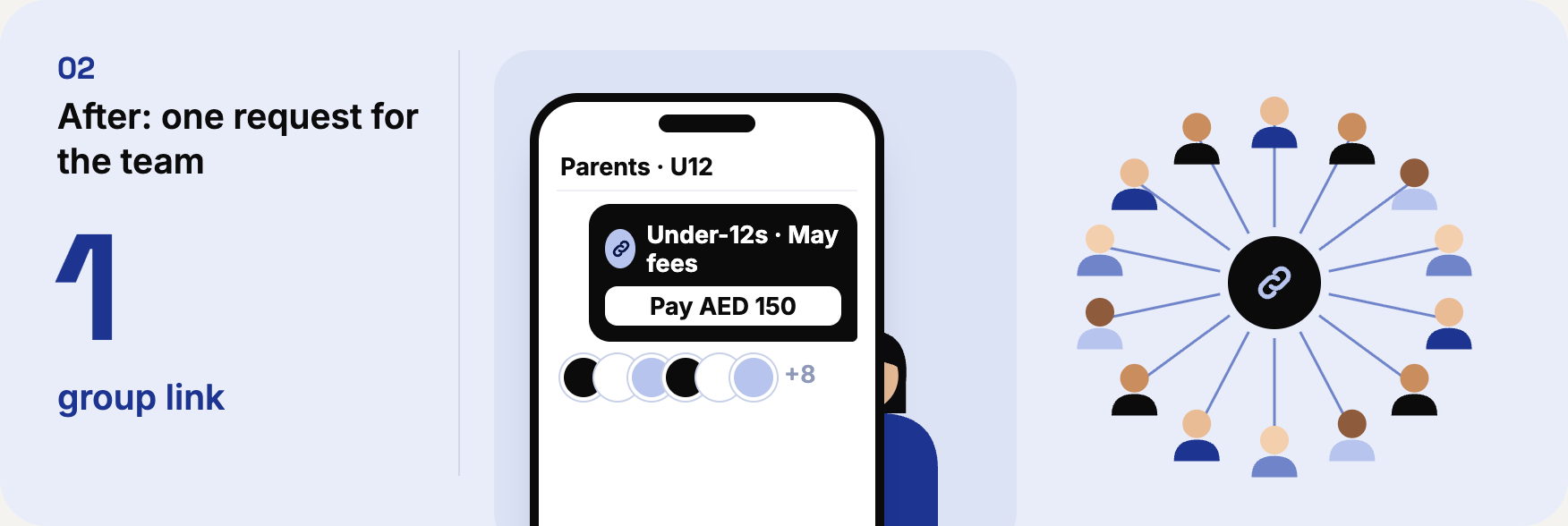
~50links per weekly session
ObservedAround 70% of Paylinks repeated earlier requests. One academy created 50 links per session, while a florist entered the same description over 1,000 times.
InterpretationMerchants weren't just repeating transactions. They were recreating the same work for different customers.
DecisionExplore group payment requests and saved prices to eliminate repeated setup.
StatusProposed in the prototype. Adoption and time savings require validation.
Signal 02

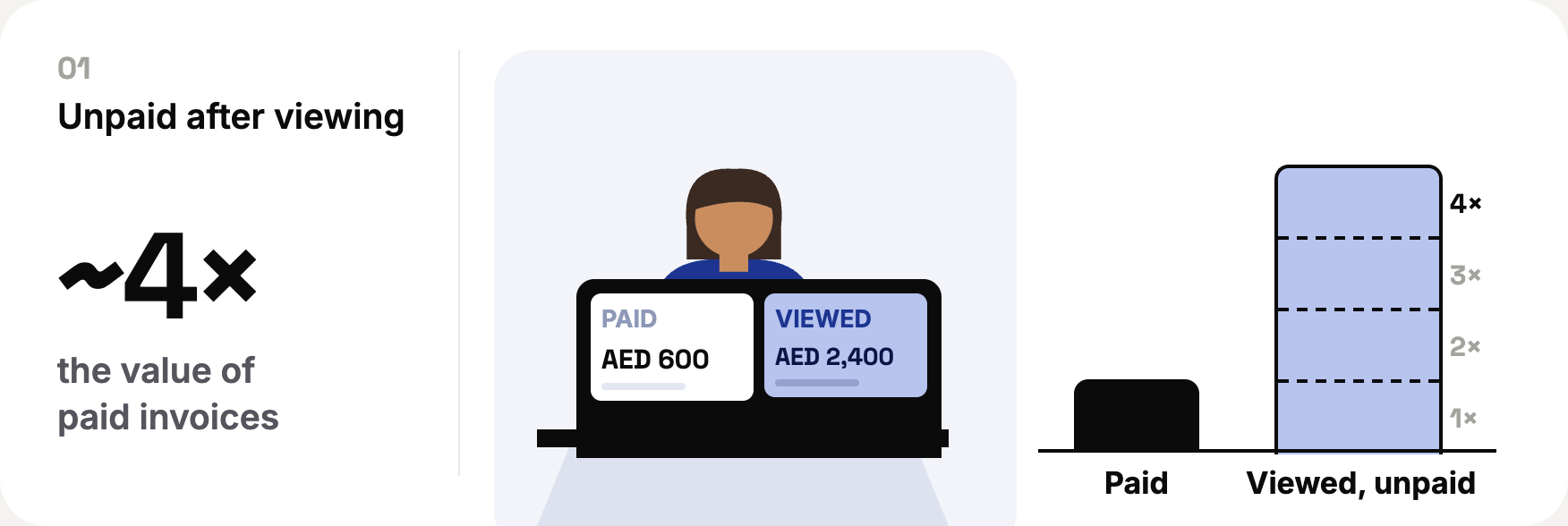
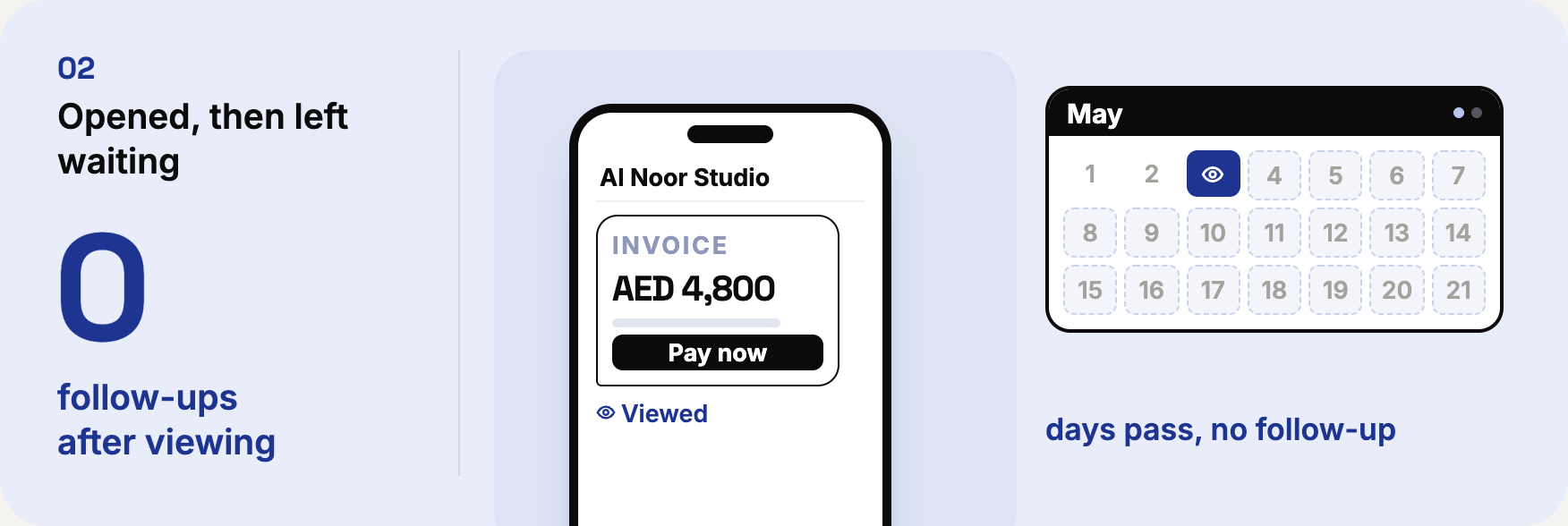
Viewed, but still unpaid.

~4×the value of paid ones
ObservedAround 2,000 invoices were viewed but unpaid, with values roughly 4× those of paid invoices. Yet over 1,000 others were paid after the first day.
InterpretationViewing didn't guarantee payment, but delayed payments showed that collection wasn't always lost.
DecisionExplore timely reminders and flexible payment options, including deposits for larger invoices.
StatusDesigned in Get Paid. The effect on paid rate is a pilot target, not a result.
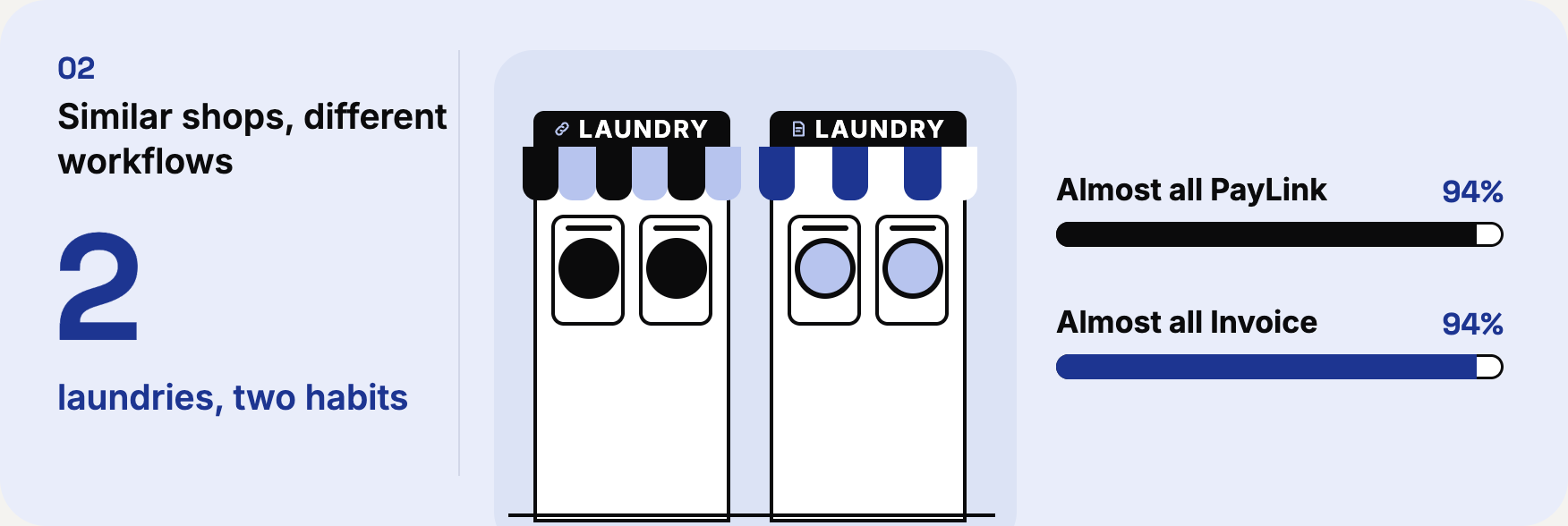
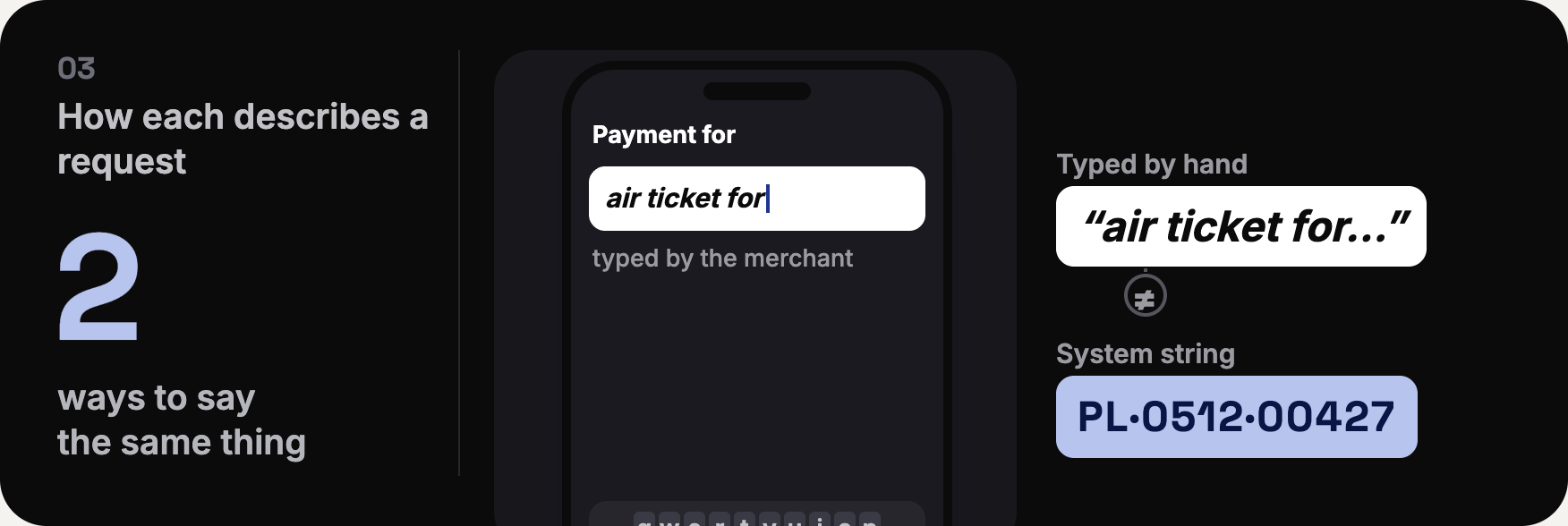
Signal 03

Same trade. Different payment tools.
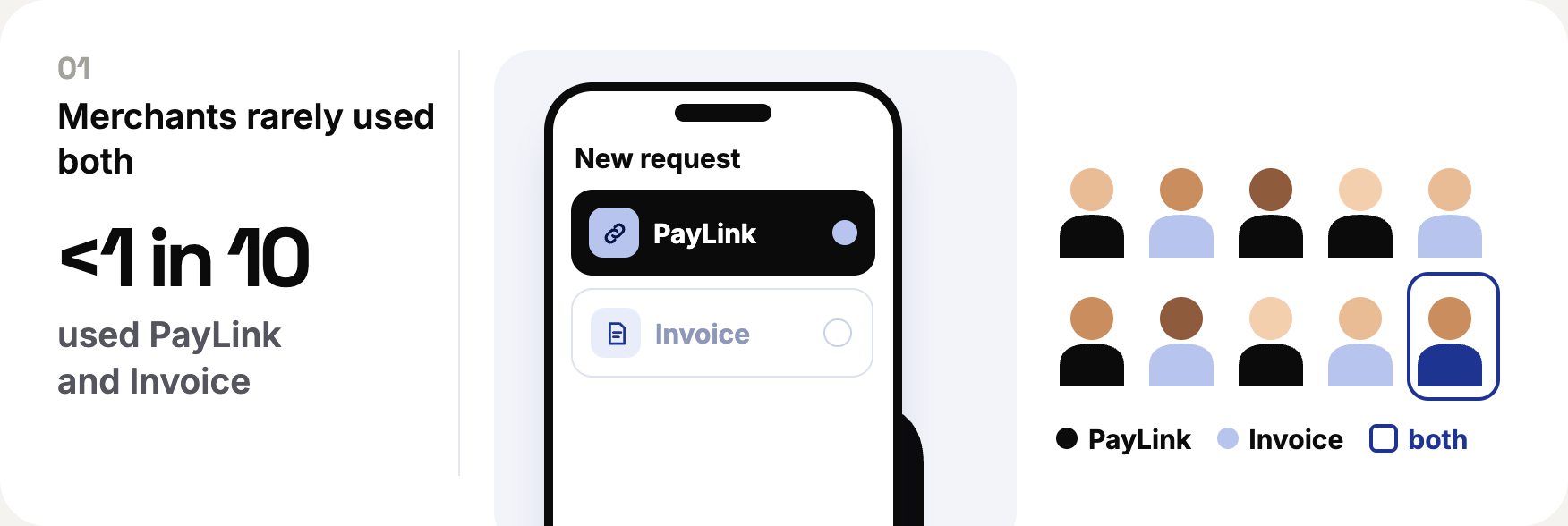
<1 in 10merchants used both products
ObservedFewer than 10% of merchants used both Paylink and Invoice. Even businesses in the same trade relied on different products, despite similar payment amounts.
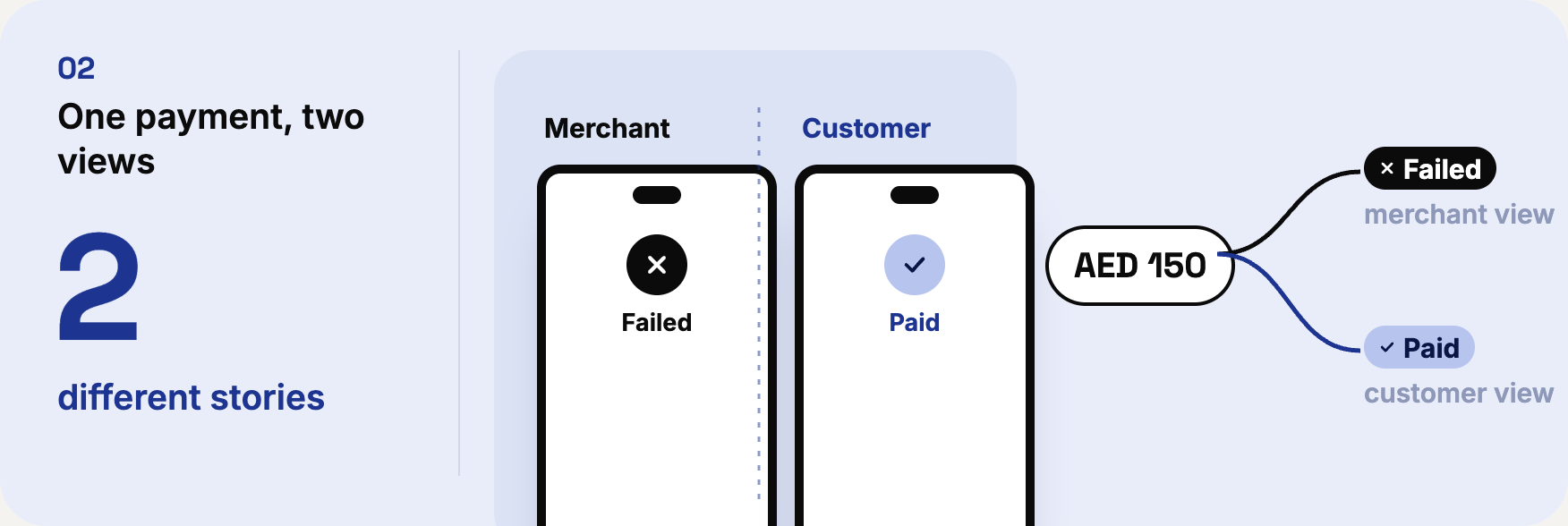
InterpretationProduct choice appeared to depend more on how merchants started than what they needed.
DecisionDesign one shared payment record, accessible through different entry points.
StatusDesigned, and tested in two prototypes with two merchants.
Signal 04

Getting paid early was linked to coming back.
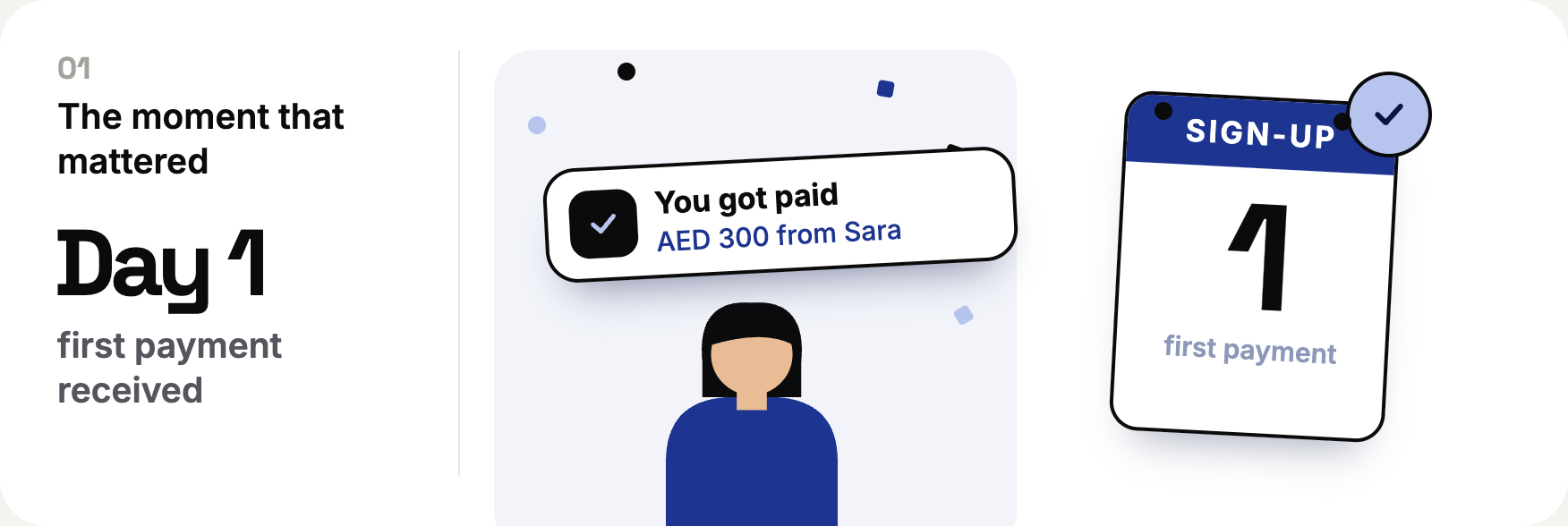
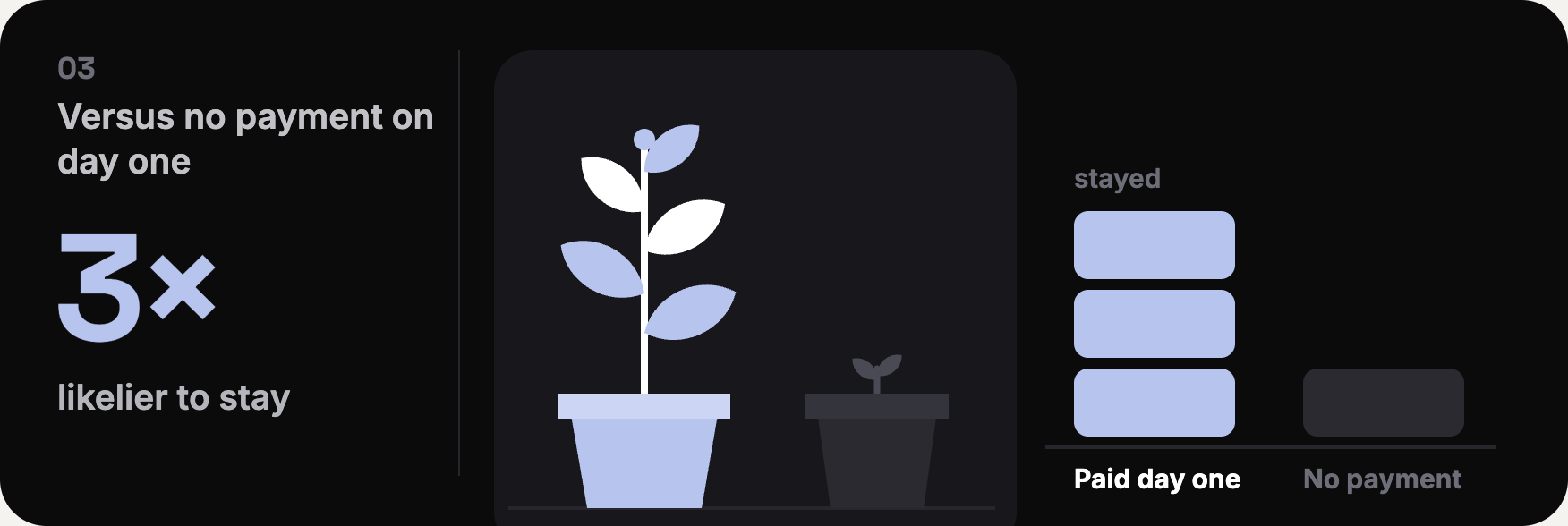
3×more likely to stay
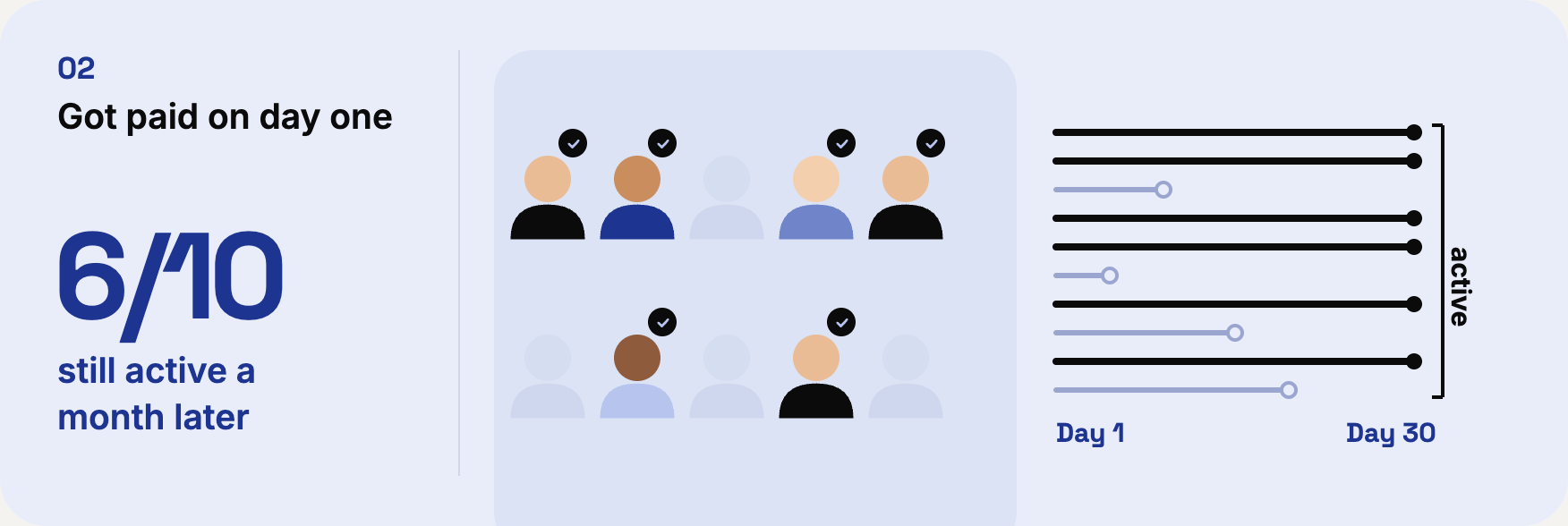
ObservedMerchants who received payment on day one were roughly 3× as likely to still use Paylink a month later.
InterpretationCreating a link meant getting started. Receiving payment meant experiencing the product's value.
DecisionMake the first successful payment the onboarding milestone, not the first link created.
StatusDesigned. The day-one paid share is a pilot target, not a result.
Two smaller signals
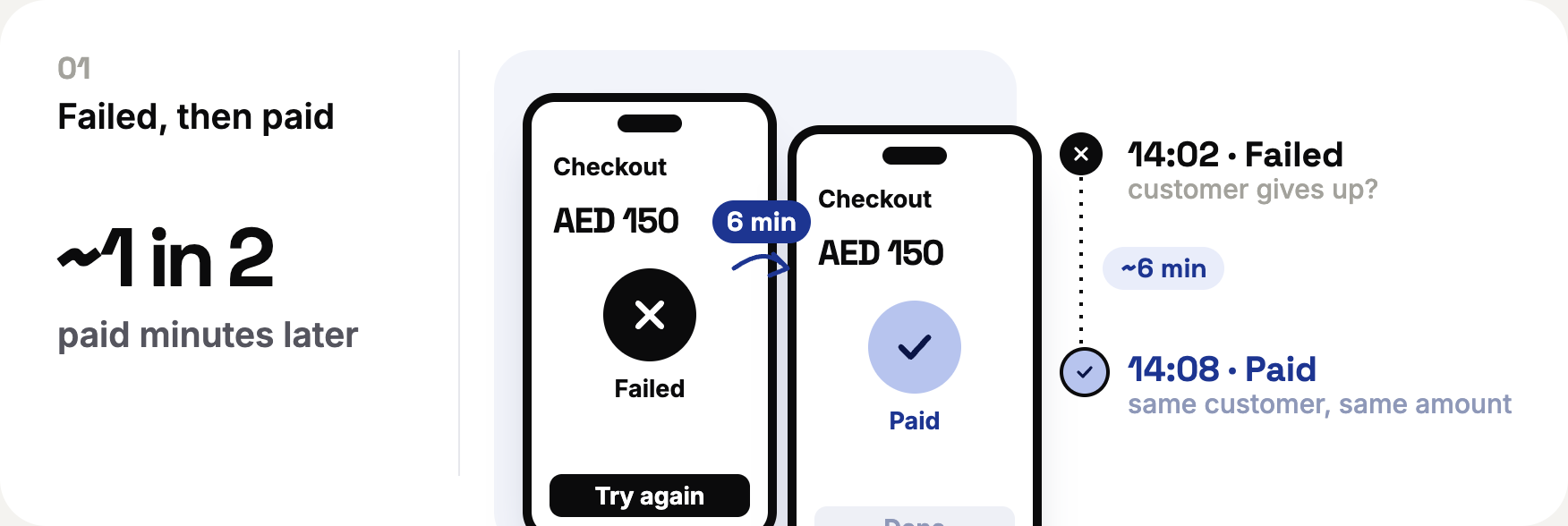
Smaller signal 01A failed attempt wasn't always a lost payment.
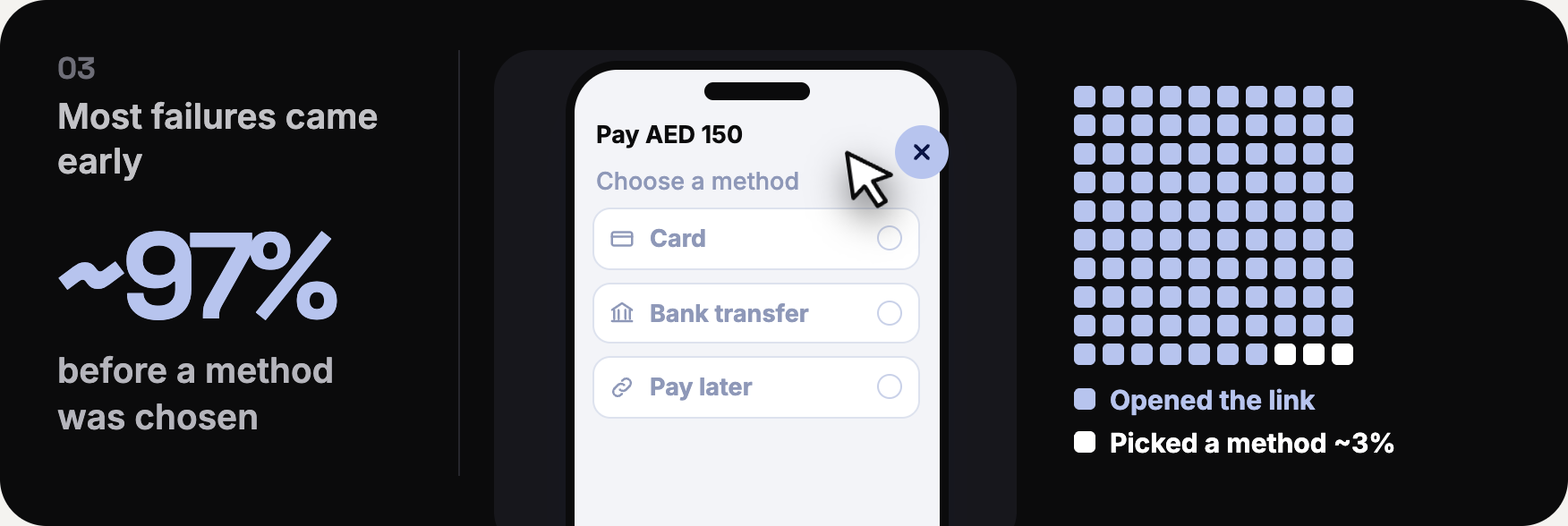
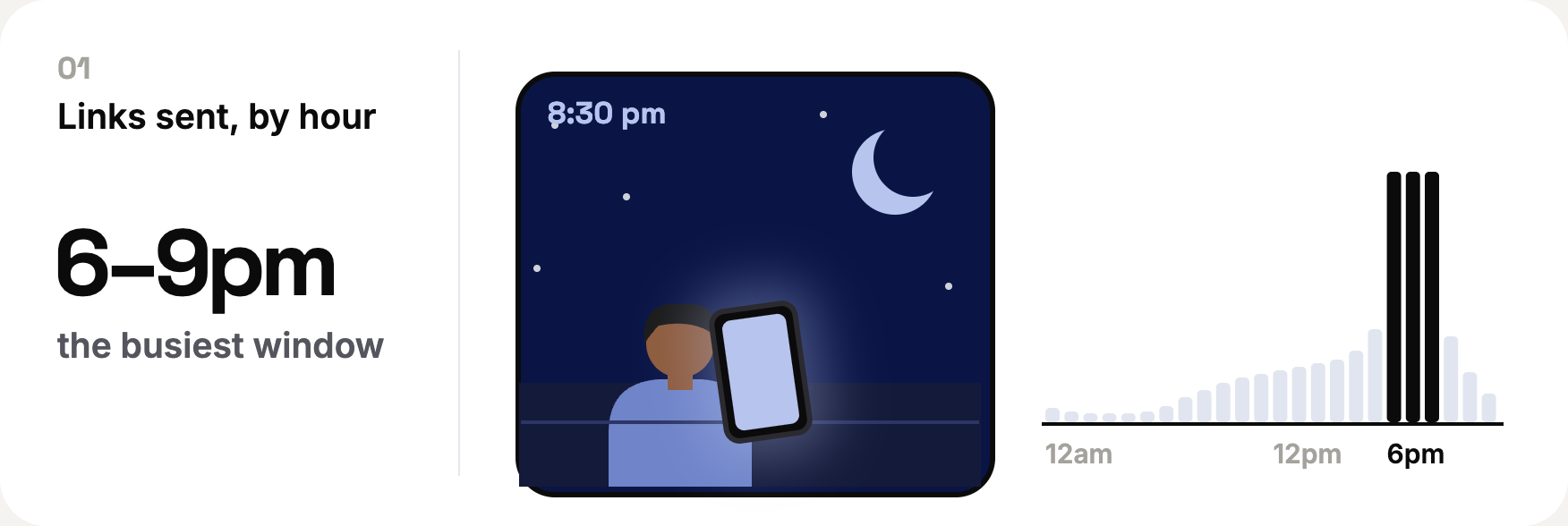
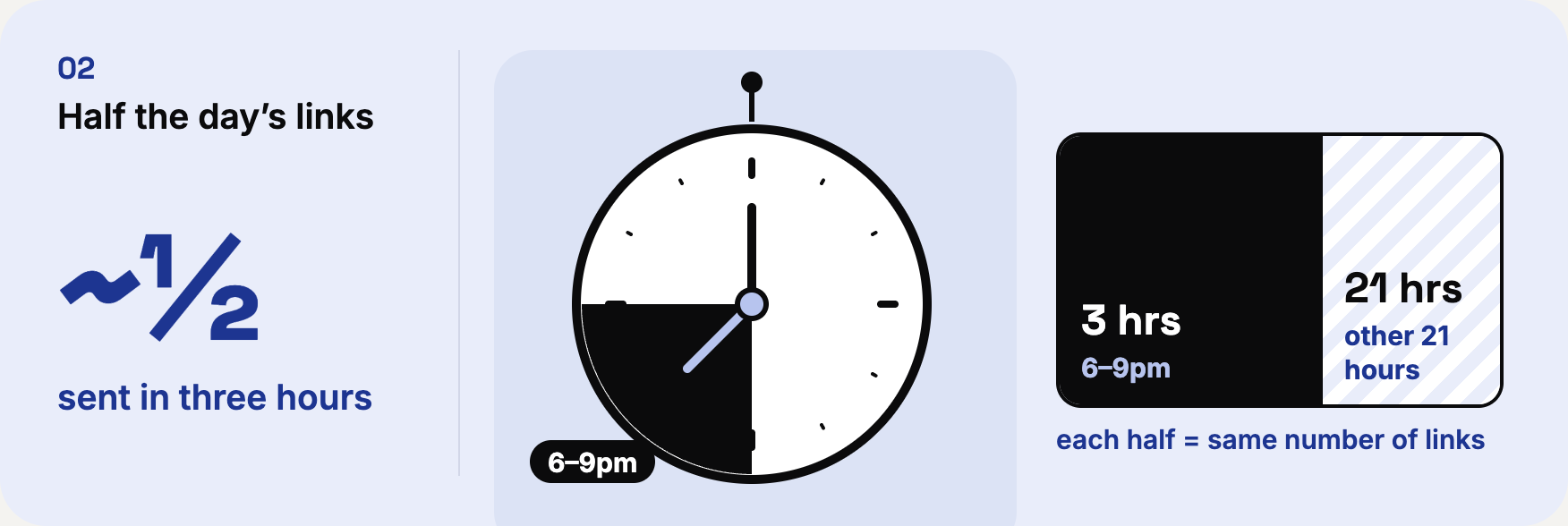
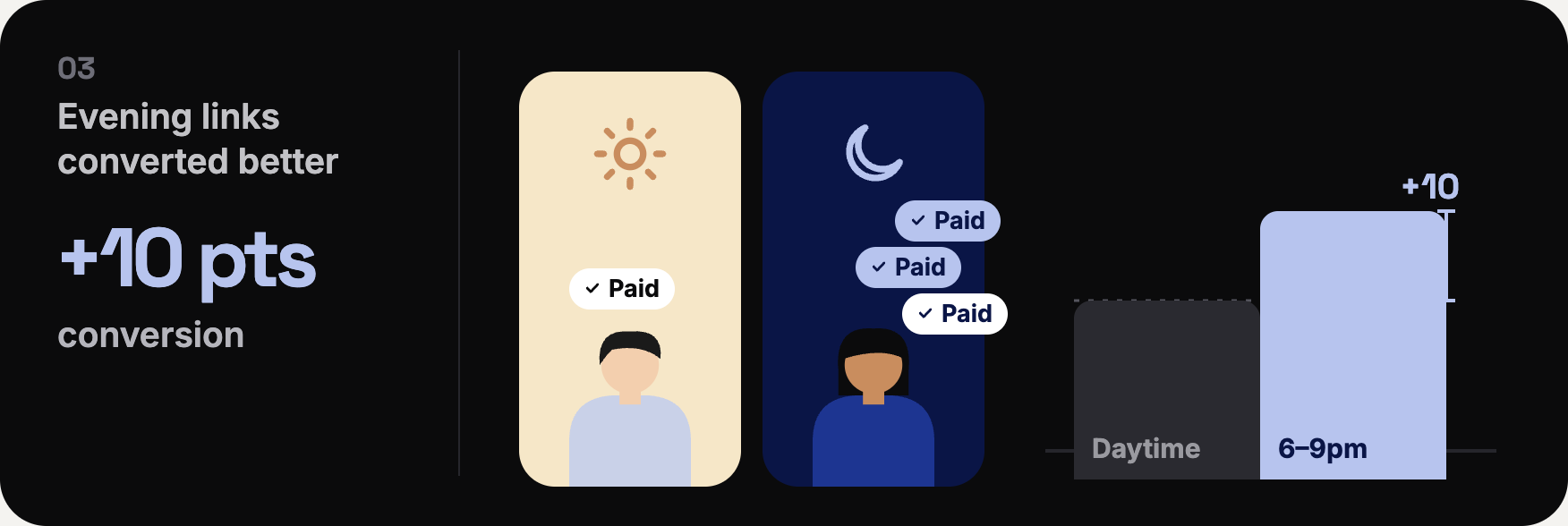
Smaller signal 02Evenings were a key payment window.

When merchants sent requests mattered · hourly bars are illustrative

How did merchants already use PayLink?

Same Paylink. Four very different jobs.

When each merchant sent requests, and for how much.

{{ fp.cur.name }}{{ fp.cur.need }}
Design direction{{ fp.cur.dir }}
{{ fp.cur.annot }}AED, log scale · time of day
10k1k100108am12pm4pm8pm10pm
Same axes for all four · amount up, time of day across
{{ fp.name_academy }}
{{ fp.name_florist }}
{{ fp.name_travel }}
{{ fp.name_laundry }}
How long does one invoice actually take?

{{ wkTitle }}

Current experience · {{ wkFlowL }}
{{ wkSoFar }}/{{ wkTotal }}taps so far · {{ wkStepTaps }}

{{ wkCur.head }}

{{ wkScr.url }}
Business{{ n.l }}
{{ wkScr.title }}Step {{ wkCur.n }}
{{ x.l }}
{{ r.l }}{{ r.v }}
PDFInvoice number{{ r.l }}
{{ r.l }}
{{ r.l }}
{{ r.l }}
Highlighted: where it breaks
The friction

{{ wkCur.fr }}

Why it matters

{{ wkCur.why }}

All of Discovery, on one boardThis board is where the evidence turned into bets.
Research and ideation board: frame, evidence, sources, strategy and hypothesesOpen full sizeResearch and ideation board. Select a step to spotlight it on the board.
1FrameThe design question: get paid without choosing a product.→ The brief
2Evidence~90K transactions, both journeys walked, external research.→ Signals 01–03
3SourcesProblem analysis, user and KYC data, merchant verticals, behaviour.→ The audit above
4StrategyOne payment request object, ranked P0 to P2.→ Decisions 01–05
5HypothesesEach bet mapped to evidence, marked tested or open.→ 7 testable bets

Seven bets came out of it. The first changed the question.

So what was the real problem?
Worked withProductLeadership
The original brief

{{ rf.from }}

How might we help a merchantget paid, from the first requestto the money landing, without makingthem understand which product to use?

The focus moved beyond individual features to the work merchants had to do throughout the payment process.

What did you decide to build?

Five decisions, and the evidence behind each one.

I made the design ask one question first: who’s paying you? Everything that used to be buried in settings follows from the answer.

Decision 01

Start with the payer, not the product.

1question instead of two products

Rather than choosing Paylink or Invoice, merchants start with who needs to pay: one customer, anyone with a link, or a group. The request adapts, showing additional details only when needed.

One starting pointRelevant fields and defaults
WhyMy two merchant interviews revealed different needs. Instead of forcing one default, I designed a starting point that could accommodate both.
Decision 02

Stop rebuilding the same sale.

50links. One recurring collection.

Merchants can repeat previous requests, save common prices, or collect from a group while tracking each payment individually.

Group collection with individual trackingSaved prices and repeat requests
WhyThe academy recreated around 50 links per session. The florist repeatedly entered the same products. Both were spending time on work they had already done.
Decision 03

Show what happened. Then what to do.

6states. Clear next steps.

Give merchants a clear view of each request, from sending to payment, with relevant reminders, payment updates and receipts. Track settlement separately.

Shared payment progressActions based on the latest status
WhySome failed attempts were followed by successful payments. Merchants needed to know what happened next, not just that something failed.
Decision 04 · From interviews

Show the money before sending.

Feesbefore branding

Before sharing a request, merchants see what the customer pays, estimated fees, the amount they will receive, and expected settlement timing.

Before you send · AED 2,600 requestEstimate
Customer paysAED 2,600
Estimated fee− AED 65
You receiveAED 2,535
SettlementExpected date shown here
Illustrative amounts. The fee is labelled as an estimate until the payment is confirmed. Paid and settled are tracked separately.
Clear payment breakdownBranding managed in Settings
WhyBoth merchants wanted clarity on charges and deductions. That mattered more to them than customising how the request looked.
Decision 05

Give bigger payments a smaller first step.

~90%of unpaid value sat in larger requests

Let merchants request a deposit upfront and collect the remaining balance later, with both payments tracked together.

Flexible depositsClear outstanding balance and due date
WhyRequests above roughly AED 1,000 accounted for about a quarter of requests but most of the unpaid value. Deposits were worth testing, not assuming.
What does it look like for a merchant?

Initial prototypes, built for chat.

Where millions of merchants and customers already talk every day. Both are live, so try them. They fed into the final Get Paid design.

Worked withEngineeringMerchantsOperations
Interaction rules

Once it’s sent, the amount is locked. To change it, you cancel and resend. The system owns expiry, not the merchant’s memory. Both sides read the same request. Paying happens inside the chat wherever possible. A decline says whether you can retry, and always confirms when nothing was charged.

Merchant flow
Start from existing context→Confirm prefilled draft→Add required structure→Review payer-facing version→Fix validation issues→Choose payment + delivery→Send→Track lifecycle
Payer flow
Receive verified invoice→Understand merchant + amount→Review line items + tax→Pay→Receive receipt
Product shift

The PDF is just one output. The real thing is the record, and it carries payment, delivery, status, reminders, the receipt and reconciliation.

Prototype testing

Tested with merchants.

01How they responded to the prototypes

Same product, two completely different mental models.

Two daily PayLink users. Two opposite reactions to the prototypes.

Tested withPayBubbleInvoice Autopilot↑ from above
Swipe to see the full diagram →
01
Sports events companyThe owner sends links himselfWants shortcuts
≠
02
Rental company with an ERPIts system does the askingWants reliable APIs
link
The owner, by hand
Creates the link
ERPlinklinklink
Their system, automatically
AED 150
Fixed by the merchant
Amount
AED pay part
Customer chooses, or pays part
23:59
Shorter, for urgency
Expiry
never
expires
No expiry
→Pay
The merchant
Starts the payment
Pay now
The customer
✓ PayBubble fittedLocked amount, 24-hour expiry, merchant-only start: all matched.
PayBubble test
✕ PayBubble brokeTheir system creates links, customers set amounts, links never expire.
Where they met
01Shortcuts, by hand02APIs, automated
Both agreed
No branding while creating
Invoices live outside BOTIM
Paid over WhatsApp or SMS
So one flow bends to both3 rules became configurable
The amount is lockedFixed, or the customer sets it
Expires within 24 hoursMerchant picks the expiry, or none
Only the merchant startsMerchant or their system starts it
Stayed shared on every pathOne request recordOne set of statesFees shown before sendingNo branding while creating
02What it changed

The research turned two prototypes into one request.

Merchants thought in sales, not products. So both prototypes became two ways into one request.

Where they live

Both lead to the same place: Get Paid.

PayBubble Invoice Autopilot
Get Paid

PayBubble and Invoice Autopilot are two doors into one surface. 29 screens, one request record underneath.

Choose customer
Review request
Home
Customer view
Paid
The final product

From the first request to money in the wallet.

Every Get Paid screen, in the order a merchant meets them. Pick a stage or use the arrows.

The core path, in five screens
Or browse all 29 by stage
01 / 29Set upPayBubble and Invoice Autopilot
Home

Still to collect, in wallet and overdue on one card. Open requests sit below.

Get PaidProduct architecture

Every Get Paid path writes to the same record.

Pick a path to see what it touches. How it starts and where it goes can change. The record never does.

01Sports events company · shortcuts, by hand02Rental company · APIs, automatedMarked where each one enters
How it starts
Entry
Where it starts
Varies by path
Get Paid tab+ in chatHold to invoiceRepeat last01Business appAPI / Import02
Create
What kind of ask
Varies by path
Quick requestStructured invoiceOpen collectionGroup, each payer tracked
Record
What it is
Same on every path
One payment request
MerchantPayerAmountPurposeItems and VATScheduleExpiryMethods
Where it goes
Deliver
How it travels
Varies by path
In the chatLinkQRWhatsAppEmailSMS
Lifecycle
What happens to it
One set of states
DraftSentViewedPartly paidPaidSettled · merchant side, tracked separately
Outputs
What it leaves behind
Varies by path
ReceiptMoneyReconciliation
What runs underneath
Services
Shared by every path
Same on every path
Payments + 3DSTax checksRemindersMemoryLedgerWallet · Pay, Aani
Screens on this pathSelect one to open it above
What did you change after testing?

Four things I got wrong in the first version.

V1 made the flow shorter, but merchants were still guessing. V2 tells them what’s happening and what to do next.

72%Almost there
?
Continue
? What is the missing 28%?
Standard
Tax invoice
Proforma
Simplified tax
Choose invoice type? Which one do I need?
Customer
Send via WhatsApp
Line items
Line items
Validate TRN
VAT
Due date
Delivery
Terms
Validate and send
! TRN invalid! Due date missing! VAT not set
? Errors appear only at the end
What the merchant saw
Payer taps PaySuccessfulBank confirms
Told it worked before the bank did.
? Told it worked too early
2 details leftInvoice to Maya Hassan · AED 2,600
✓Customer
✓Line items
✓VAT
Customer TRN+ Add
Due date+ Add
✓ Exactly what is left
RecommendedTax invoiceVAT itemised, TRN on the invoice.Change type
MHMaya HassanTRN on file
✓ Decided from the customer TRN
‹New invoiceStep 2 of 3
✓Details
2Review
3Send
As Maya will see itTax invoice
AED 2,600
Line items3
VAT · TRN✓ Fixed in Details
Due dateSet
Continue to Send →
✓ One step at a time
‹Payment statusLive
NINadia InteriorsFrom Maya HassanAED 2,600
✓Started
·Bank check
✓Paid
ProcessingThe payer tapped Pay. The bank is still checking, so this does not say Paid yet.
✓ PaidShown only after the bank confirmed. Receipt sent to Maya.
Done
✓ Confirmed before it says Paid
V1 · PayBubble & Invoice Autopilot V2 · Revised flow
Drag to compare01 / 04
What did it cost you?

Every time I unified something, I had to give something up.

Pick one to see where I landed.

One complete journey

One request, end to end, including a failure.

The same AED 2,600 invoice from Nadia Interiors to Maya Hassan. Each step shows what the merchant and the customer see, and which state the request is in.

  1. 01Sent
    Review and send
    MerchantSees the invoice as Maya will, then sends it.
  2. 02Viewed
    Customer opens it
    CustomerSees Nadia Interiors and AED 2,600 before anything else.
  3. 03Started
    Customer taps Pay
    CustomerStarts the payment. The amount is locked.
  4. 04Processing
    Bank still checking
    BothProcessing. It does not say Paid yet.
  5. 05aFailed
    Declined
    CustomerDeclined. Nothing was charged. Try again or use another method.
    MerchantAttempt failed. The request stays open.
    Proposed extension
  6. 05bPaid
    Confirmed
    CustomerPaid, with a receipt sent to Maya.
    MerchantPaid, only after the bank confirms.
  7. 06Settled
    Money lands
    MerchantSettled shows separately, when the money reaches the wallet.
What each person seesThe merchant and the customer read the same request and the same state, worded for their side.
Is retry safe?After a decline, yes, because a decline always confirms that nothing was charged. While it is Processing, the screen says the bank is still checking.
Did money move?Paid appears only after the bank confirms. Settled is a separate, merchant-side state.

Steps 01 to 04, 05b and 06 come from the Get Paid screens and the revised payment status. The decline state is a proposed extension, built on PayBubble’s rule that a decline says whether you can retry and confirms when nothing was charged.

Where it stands

What I delivered, what testing changed, and what is still unproven.

DeliveredDone
  • A product model: one request record behind every way of asking for money.
  • Get Paid: 29 screens, from the first request to money in the wallet.
  • Two prototypes, PayBubble and Invoice Autopilot, tested with merchants.
  • Pilot targets and guardrails, agreed with product, data and leadership.
What testing changedObserved
  • Two prototypes became two ways into one request.
  • Amount, expiry and who creates a request became configurable.
  • Progress lists the missing fields instead of a percentage.
  • The invoice type is suggested from the customer’s TRN.
  • Creation split into Details, Review and Send.
  • Paid shows only after the bank confirms.
Still unprovenTargeted
  • Whether requests are faster to create in real use.
  • Whether repeat requests and saved prices get adopted.
  • Whether reminders raise the paid rate of viewed invoices.
  • Whether deposits help larger invoices get paid.
  • Days to cleared money: ~17 today, 6 is a target.
The primary pilot question

Can merchants create an accurate payment request faster without losing clarity about fees and payment terms?

Measured by task completion time alongside errors and understanding. Collection outcomes are tracked separately, because faster creation does not automatically mean faster payment.

So what changes for merchants?
The data got me started.What I actually delivered was a new product model.
Worked withProductDataLeadership

We agreed the north star and the guardrails as targets for a 10-merchant pilot.

Nadia Interiorsmerchant · illustrative

So how much faster do I actually get paid?

Target: about 6 days from invoice to cleared money, down from ~17 today.

Invoice created to cleared payment1 box = 1 day
Before~17 days
Target6 days

And making a request in the first place?

Seconds, not minutes. Repeats are one tap.

Basic request40–60s<30s
Repeat requestrebuilt<10s
First invoice ever~6 min<90s
Repeat invoice~3 min<30s

Will people actually pay on time?

Target: from 1 in 2 paid by the due date to 4 in 5.

Before~50%
Target~80%
More viewed invoices paid within 3 daysMore new merchants paid on day one

What about the invoices people saw and never paid?

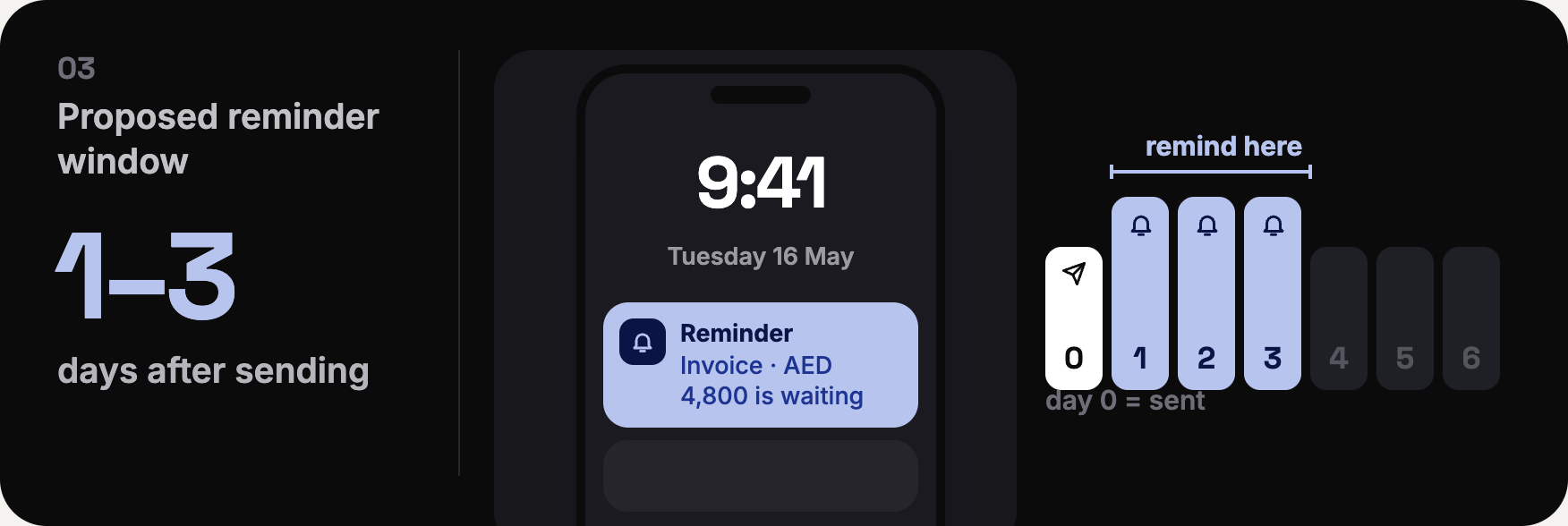
~2,000 of them, worth ~AED 5.5M. Reminders go out on day 1, 3 and 7, and stop the moment you’re paid.

Day 1Day 3Day 7Paid · stops

Faster usually means more mistakes.

Guardrails: none of these should get worse.

<1%corrections after send
2 tapsto pay, no account
0compliance fails · 15 of 15 TRN digits checked
Stopsevery reminder, at payment
Piloted with 10 merchantsHow each goal was measured
GoalBeforeHow we measured
Basic request in under 30s, 3 to 4 taps
40 to 60s, about 6 taps
Timed task test with pilot merchants
Repeat request in under 10s
Rebuilt from scratch every time
Share of requests made with Repeat last or a saved price
More viewed invoices paid within 3 days
Late payments happen, nothing prompts them
Paid rate of viewed invoices, before and after reminders
Fewer “did you pay?” messages
PayLink has no status beyond paid or failed
Merchant survey and support tickets
More merchants paid on day one
Onboarding ends at “link created”
Share of new merchants with a paid request in 24h
The guardrailOnce someone picks a payment method, it already works almost every time. I made sure nothing in the redesign touches that step.
How did your thinking move?
01♠The briefI was asked to improve PayLink and Invoice.
02♠The dataTens of thousands of payment records said the same thing: merchants didn’t care which product they used. They just wanted to get paid.
03♠The researchOne merchant wanted faster manual creation. The other barely touched the UI because his system did it all.
04♠The modelSo I stopped redesigning screens and joined up the system underneath them.
05♠What I’d do differentlyI’d show merchants PayBubble and Invoice Autopilot side by side from the first session. Seeing both together would have made the case for one record sooner.
06♠How I run sessions nowI send merchants a working prototype before the session, and ask them to show me their last real sale instead of describing what they’d like.
07♠Next · measureInstrument the payment page. The data tells me where customers drop off, not why.
08♠Next · roll outRelease in stages, track the same goals at scale, and keep the guardrail: nothing touches the step where payment already works.
09♠What I’m taking with meThe headline numbers were true, but they weren’t useful. The insight was always one cut deeper: when the repeats happened, how big the unpaid invoices were, which product a merchant found first.
If your team is working on problems like this, I’d love to talk.
khansarubiarto@gmail.com
Say hello
Khansa Rubiarto · {{ cs.position }}